
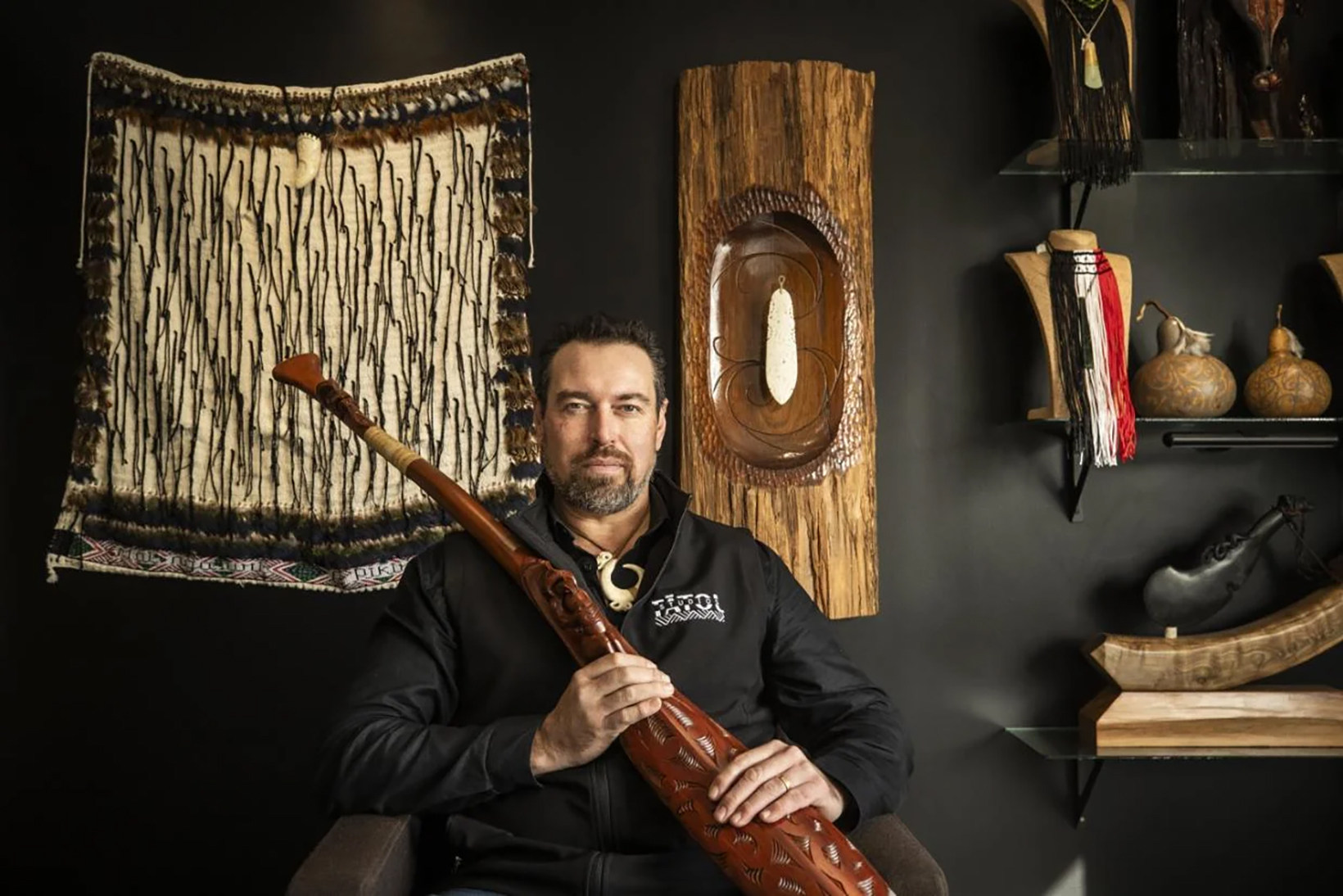
Nelson City Māori Ward Councillor Kahu Paki Paki at his studio in Annesbrook.
It’s essential that Māori wards are retained in Aotearoa
Teresa O’Connor is a former reporter, former co-editor of Kai Tiaki Nursing New Zealand and a former Nelson Mail columnist. She is currently the co-ordinator of Maori Wards Work – Whakatu.
OPINION: Nelsonians must vote to keep the Nelson City Council’s Māori ward in the local body elections now under way. Why? Because retaining the Māori ward here, in Tasman, in Wairau and across the motu is essential democracy.
These kinds of statements about Maori Wards being “essential democracy” show that either the author does not understand what democracy is, or they are hoping that the reader does not understand what it means and will just accept and believe the statement without checking. We have a page here describing exactly what Democracy is for anyone who is unsure.
When citizens run for local body elections and become council members, their job is to, broadly, take care of their area of authority in the best interests of the people who live within that area as a whole, regardless of the race, religion, gender or any other identity group of the people within. These citizens get to choose, through the democratic process of elections and voting, who they want in those jobs, and can also remove those people during the next election cycle if they have not performed their duties to the satisfaction of the voting citizens. This is democracy in action.
Conversely, Maori Wards are focused entirely on the best interests of one race, Maori, only. Their entire reason for being is to ensure that Maori receive advantages over everyone else. To insert the Maori World View, Maori spiritualism, Maori animism, and other Maori cultural beliefs into the decision making of Council, as though it is more important and more relevant than the culture and beliefs of all other citizens. They strongly advocate for Maori pet project funding and a spend of rate payers money which is disproportionate to their contribution to the good of the citizens and rate payers as a whole, which is virtually nil.
Council members who are there to represent the Maori Ward in their area are voted to that position by Maori only, and can be removed through votes by Maori only, yet these Councilors have full voting rights in council over issues which affect ALL the citizens and rate payers in the area. This is not democracy and it is not fair.
It is also essential for justice, for fair and inclusive representation, for better informed decision-making and to honour our partnership under Te Tiriti o Waitangi.
The 3rd Article of the Treaty of Waitangi says “In consideration thereof Her Majesty the Queen of England extends to the Natives of New Zealand Her royal protection and imparts to them all the Rights and Privileges of British Subjects.” This is pretty clear. No-where in the TOW does the word “partnership” appear. Nor is it implied. In fact, as honorary British Subjects it is legally and constitutionally impossible to be in partnership with the Crown.
This myth was brought about when a Judge, carelessly, stated that the Treaty of Waitangi was “like a partnership”. This was an opinion expressed in the context of the rest of his dissertation. It was not a statement that the Treaty of Waitangi was indeed a partnership. There is a world of difference between being “like” something and actually being something. Yet radical Maori activists seized onto the word “partnership” and have, through their usual tactics of pressure and intimidation, virtually spoken it into existence. Exactly in the same way they have enforced “the principles of the Treaty”, which can be found no-where near the Treaty but are referenced all over our laws and regulations.
This Government, as part of its Coalition Agreement with ACT and New Zealand First, has called on all councils with Māori wards to hold a referendum on whether to keep or scrap them for the 2028 and 2031 local body elections.
The referendum is taking place in the face of 40 local authorities which already have Māori wards voting to retain them.
Who, exactly, voted to retain them? Was it the Maori ward citizens who got to vote? Was it just Council who voted? Or did the entire population under each Council’s area of authority have a vote – because that is the only democratic way to decide.
The referendum is unnecessary, unfair and unjust. It is unnecessary because of councils’ endorsement of Māori wards.
The referendum is absolutely necessary as it is the only way to ensure ALL the people get a chance to vote, and not just the few in Council who are, as a small group of individuals, easy to pressure and intimidate or otherwise persuade to vote for the status quo.
Nelson City councillors have publicly spoken of the value of having Kahu Paki Paki at the table. His presence has saved the council in consultation costs and undoubtedly legal costs.
But not all value can be measured in dollars and having a te ao Māori perspective at council table brings many other benefits, not least of which is the willingness to take a far longer view than the three-year electoral cycle.
It is unfair because it gives the majority (ie Pakeha) the ability to decide what is best for the minority (Māori).
First of all, life isn’t fair, something we all learn early in life and have to live with. There are many things in life that will seem unfair to some people and perfectly fair to others – that’s just life. It has also always been a fact of life that “majority rules”. This is because it is virtually impossible to please everyone with a rule or law, or many other decisions, so in order to keep as many people as possible “happy” with a decision is to find in favor of the many rather than the few. This has nothing to do with race or religion or any other identity. It is simply the way to upset or inconvenience the least people possible. It never feels “fair” to the people of the few at the time, yet another decision on a different subject may very well mean that many who were in the “few” before, now find themselves in the majority and this is what makes it fair in the long run.
This is democracy. It’s not perfect but it is the best system ever invented and one that has endured for this very reason. Any other perversion of this system is not democratic, and is therefore, not democracy.
The tyranny of the majority cannot be used to exclude tangata whenua from their rightful place at all decision- making tables.
Yet the author is quite happy to hold the majority of the ratepayers and citizens to ransom using the tyranny of the minority with the special rights they demand and intimidate out of us. There is no innate “right” to a place at the decision – making table. There is only an earned place. And the work required to earn that place is exactly the same for any race who wants to be there, including Pakeha.
In the history of the NCC and its predecessors, only three Māori have ever been elected; Ben Hippolite in the 1960s; well-known local broadcaster Jason Wawatai in the late 80s; and Kahu Paki Paki in 2022.
The paucity of Māori perspectives in our city’s governance has undoubtedly impoverished the cultural and intellectual development of our city. A Māori ward is a small way of attempting to balance the scales of local democracy.
The only democratic way to increase the Maori voice in Council is for Maori people to run for and get elected to Council in the normal way that everyone else does. Not through a privileged seat representing Maori only in a Maori Ward.
If there is a “paucity of Maori perspectives” in a city, that means that there are not many Maori who are interested enough in speaking up for Maori from inside the system, who will put in the work to get there. If there are not enough Maori interested enough to stand for Council, then maybe that means they are not that unhappy with things as they are. If too few Maori feel strongly enough to stand, then maybe it’s not the problem some people think it is. Just maybe most Maori are quite happy with how their city is being run and it’s only those few Maori with an activist mindset, who arrogantly flatter themselves with thoughts of how they only want to “help their people” by demanding unearned special rights and privileges and who want to take the easy road in through Maori wards and stir everything up, whether other Maori want them to or not.
If, as Abraham Lincoln said, democracy is the government of the people, by the people, for the people, then tangata whenua must be included in that governance.
And the only way to know if you have a government of the people, by the people, for the people, is to ask the people, which is why a referendum is essential.
And there is no referendum required for rural wards, which are in place to ensure the voice of rural communities is not drowned out by urban voters’ concerns.
It is unjust because it tramples on the mana of Māori and does not uphold the spirit of partnership embodied in Te Tiriti o Waitangi.
This so called “mana” is so over-used and basically means that it is not appropriate for any non-Maori person to disagree with any Maori person because it might hurt their feelings. This has nothing to do with justice and I’ve already addressed the partnership debate.
Māori representation at local government level is a matter of equity and social justice.
The cries of the woke brigade. What it really is is an attempt to get a foothold in the door of local government as part of the plans to achieve He Pua Pua – Maori governance of New Zealand.
That representation gives voice to Māori who, for too long, have been excluded from genuine decision-making at national and local levels, never mind the history of oppression and dispossession they have endured for more than 180 years.
If Maori have been excluded from genuine decision-making it has been at their own lack of motivation to do anything about it. They have not been excluded by legal means for over 100 years!
The local Tenths Trust story is a tragic illustration of that ongoing oppression and dispossession.
Having a Māori voice at the council table is a way of honouring the partnership embodied in Te Tirti o Waitangi.
Again, I have already addressed the partnership lie, and feel no one should feel obliged to honour something that is based on a lie!
It is worth putting this current referendum in its historical context.
In the 185 years since Te Tiriti was signed, that partnership has been honoured more in the breach than the observance.
As noted local researcher Hilary Mitchell points out, Māori have been excluded or ringfenced to prevent any influence in local and national decision-making throughout New Zealand’s history.
The 1852 Constitution Act created a white minority government: Māori outnumbered immigrants by about 60,000 to 30,000 at the time. A property qualification allowed almost all European males (including those leasing Māori-owned land) to vote, and almost no Māori on the grounds that they owned land communally.
When Māori were finally allocated four seats in 1867, there were 72 European seats and the Māori population warranted 14 to 16 seats. It took until 1996 for the number of those seats to be increased.
Even now there are just seven Māori seats in our 120-seat parliament while the Māori population is getting close to 20%.
So to those who oppose Māori wards, saying they want everybody treated equally and no race-based mandates, our history demonstrates our Parliamentary democracy was founded on inequality and race-based mandates.
If those figures are correct, they are no justification for giving special privileges to Maori now. Maori have had more than enough time to avail themselves of a much improved situation where Maori have for decades been receiving vast amounts of taxpayers money and land to the point where they now brag at how many billions the Maori Economy is worth.
Retaining Māori wards is a very modest way of attempting to counter the enduring injustices created by that history.
In 2011, Nelson City Council voted to establish a Māori ward and that decision was overturned by a community poll in 2012. We do not want to repeat that racist history.
That was not racist. It was Democracy in Action. It has nothing to do with racism. It’s the principle of standing up for our democratic rights and freedoms.
Nelsonians are proud of our region’s natural beauty, its creativity, its cultural vibrancy, its vibrant arts scene, its range of artisanal produce, its diversity of outdoor pursuits, its sun-soaked reputation and its relaxed, friendly vibe.
Swapping Tribalism for Democracy would ensure that those wonderful attributes of Nelson soon disappear.
Let’s maintain and enhance that image by voting for justice and genuine partnership with tangata whenua through keeping Māori wards. To do otherwise would be to make a mockery of how we imagine our city and would be a triumph of fear-based thinking.
Maori always accuse us of having fear. If what we feel about threats to our way of life, our culture, our beliefs and systems of governance and law is fear, then it’s justified fear. We’re often told “there nothing to fear”, yet time and time again our long loved way of life becomes more and more restricted as Maori gain more and more power in such things as co-governance agreements. There are many examples around the country where peoples worst fears have become reality.
We have nothing to lose and everything to gain by retaining our Māori ward.
If you happen to be one of the Maori activists involved in the governance of the Ward.
Our community, our city, our society and particularly our tamariki, will be better off when the perspectives, input, viewpoints, considerations, concerns and the long-term, inter-generational focus of Māori are respected and included in decision-making at the council table.
Our communities, cities and society and our children have been growing and thriving in all fields of accademics and the work force for many decades before Maori Wards were even thought of. Just they do overseas in every other country which survives and thrives without Maori input.
If Maori want that input they need to earn it by campaigning for and being elected for positions in governance in the same way that every other person does. That’s the ONLY democratic way.